Monday, May 25, 2015

The Rabbi's Cat, a Graphic Novel by Joann Sfar


Some months back, I saw the animated film of Joann Sfar's graphic story. So, it was a thrill to get my hands on the BD.


This is a story, I can safely tell you, where a very cynical, rather cruel, and very canny cat acquires the gift of speech. This cat happens to belong to a Rabbi. And, with the advent of speech, it proceeds to argue over various aspects of the religion, mostly with its master, but also with his master and so on. The ideas, while set in the framework of Judaism, are applicable to all religions.

Be it the art, where the nature of people, of the cat, is deftly brought out in a raw style or the sophisticated theological debates, the book is well worth reading if you are a fan of the graphic novel or love a touch of dark humour.

The drawings are very evocative and provocative. How you like them will depend on your tastes. One reviewer praises the artwork

as rich and lovely as the story, full of squiggly lines, tapestried walls, cobbled alleyways, opulent costumes and palpably warm lighting 

while, to another, it is 
mangy and unkempt as the cat, with contorted figures and scribbly lines everywhere. 

  On the last page of the BD, we read that this album is homage to all the painters of Algeria in the XXth century.

You can get a clearer picture about the author and the story from this review.

I would hesitate to add more lest I let the cat out of the bag but, if you are into graphic novels, then you should buy The Rabbi's Cat.

A glimpse of the master's art:


Thursday, May 14, 2015

The Other Side of Silence: Voices from the Partition of India by Urvashi Butalia

     I was drawn to this book because my mother’s family came over to India during the Partition. The title was also significant as I learned very little of what happened, first hand, from my mother. She always told me that she and her sister had been sent off to India long before the bloodshed began. Many years after she passed away, a cousin sister told me that, in fact, my mother had witnessed the turbulence. She also told me that my mother was in some sort of  post where she wore a uniform. But, she stressed, all this was to be kept a secret. For me, this was the other side of silence. It was, apparently, a shame to the family if a woman of those days wore a uniform!


Urvashi Butalia writes in a very bland tone, using the interview format at times, a dry descriptive note most of the time and, rarely, introduces an element of drama. We are launched into her experiences with her personal story, though, even in this, she maintains a neutral stance. Her maternal uncle chose to stay back in Pakistan and converted to Islam. She goes to meet him but her family remains convinced that he did it to acquire property. Not for a second does the academic style falter, yet it is not entirely shorn of heart.


      Indeed, many such tales emerge, where some made use of the tragic turn of events to confiscate the property of others, even that of relatives. In this way, we see to what uses the Partition was put by diverse actors.

     Throughout, Ms Butalia restrains herself from bias and, it was significant to me that she includes accounts of Hindu brutality to balance Muslim acts. I was, personally, shaken to the core when, after years of being fed, by my parents and ambient society, with the myth of Islamic tendencies to butcher, I heard a bloodcurdling first hand narrative.

      I had joined a neighbourhood sewing class in my early thirties. A dear old lady ran the class. As is the habit of age, she was wont to entertain us with tales from her youth. Mostly, it was amusing - how her mother-in-law would lead her to her husband’s bed at night and escort her back afterwards, and how the double bed has destroyed our morals.

    But, on one occasion, she graphically related how she and other young women stood on a balcony or terrace and watched Muslim families being burned alive and how they cheered.  I think I grew up in that second far beyond the capacity of my physical age.  

       As must be expected from the founder of  Kali for Women, she has a section on women which explores the violence against women. These stories range from suicides, failed and successful, honour killings where men killed the womenfolk before the other party “besmirched” the family honour and, of course, the expected rape and murder of women on both sides. Yet, the author manages to find the unexpected in all this - a love story albeit a tragic one where a girl, sold over and over, finally lands up with a man who loves her, only to be snatched from him in the initiative of the respective governments to restore  abducted women to their families. Butalia also had to face being the object of violent loathing when she was personally party to one  such restoration. It is not always simple and straightforward to set past wrongs aright.  

One snippet stands out in my memory of the reading: an incident where a Britisher tells an Indian employee that they, the British, are leaving India but not without creating havoc. There is, thus, an indictment of sorts, something of which we are all, we who were and are, involved, aware at some level or the other.

   Although the book is hard to read for the most part, given the textbook like nature of its treatment, it has places where a more human face emerges - a whole section is devoted to one particular lady. In this part, the style becomes more journalistic, following this woman’s experiences in the dangerous past down to her life in the present and even up to her death. It was a curious look at those violent times, seen through the eyes of a rather amazing person.

Reading this book in light of the ongoing attempt to record first person accounts from those times, raises questions: will all this lead to more heartburn?

I think not - silence is a cancer. Sweeping things under carpets is never very hygienic.  And I am convinced that many stories will emerge showing the triumph of human goodness on both sides than those which make us all hang our heads in shame.

In seeking to write this review, I came across one article which referred to 
“the harkening back to an—often mythical—past where Hindus and Muslims and Sikhs lived together in relative peace and harmony”. 
I wonder at the cynicism. I was raised with descriptions of the warm friendships between Muslims and Hindus/Sikhs, of my grandmother’s Muslim besties with whom she hung out all day, smoking a hookah and having a great time. I wonder because, even today, it is so instinctive and easy for a Hindu Indian and a Pakistani to be friends - good friends.  Especially when we meet abroad.

What if such close bonds incur jealousy? After all, should our two countries be healed and embrace business and other partnerships, will not prosperity flourish in the region? What keeps us both down benefits those who would still like to see us as barbaric in our violence, those who, most probably, orchestrated all that bloodshed back then.  

Sunday, May 10, 2015

Excerpts of Experiences with my First Expert


The pity of it is that we never considered her an expert at anything. Well, we did but we were only being tongue in cheek.

We considered her an expert at booby-traps. She’d arrange things such that, if you moved one item, a whole pile might come crashing down. Ever since she passed away, I suspect she now resides in me as I’ve become that kind of expert these days. Fact is she was adventurous as you can see from this photo.

The bond with my first expert began long before I was born. She was so eager for me to manifest and be guided by her that she cherished a song from Navrang in the late months of pregnancy when a mother-to-be gets really impatient for the surprise gift to be unwrapped.

And, when I finally popped out, she made much of me, tending to me with all the keen care of a mentor. I was massaged and cuddled and, even before I acquired language, I was aware of how much I meant to her.


This expert had all the fervour of a connoisseur of diamonds. For her, I was Sunday’s child, dhanishta nakshatram who could turn all things to gold, I was her doll, I never peed or shat without warning and, so, was always a clean baby-thus my expert systematically brainwashed me.


All through infancy, my expert provided me with all the warmth of her love. Until I got married, I always slept tightly embracing my expert.


My expert was also my bodyguard. On a nightly basis, she protected me from ghosts and geckos. When I had to pay the toilet a late-night visit, my amma was there to walk sleepily with me, thus warding off bogeyman and his hordes. At the toilet, she had to go in first to ensure that no gecko was lurking anywhere. And, should there have been one, she would manfully drive it far away from me.

From my expert I found out a lot about beauty, inner and outer. Alas, she was living the life of an ascetic when I grew into womanhood but it is from her old photos that I came to know that she was an expert in the use of cosmetics. Though I let my hair grey now even as she did, were she still here today, I'd have taken her to a salon on Mother's Day and coloured our hair just for kicks.

While grey is good, and it's not do or dye, I'd love to have seen my expert's long hair gleam with magic. Perhaps I'll work up the courage to do it alone-for her.


When I was a teenager, we once had to walk to a clinic close to midnight, as my father was hospitalised there. On the way, a man got off his cycle and blocked our path. My expert proved her worth as she instantly recognised danger and pushed me behind her and surged forward with her slipper in hand. I suspect that man was an exhibitionist for he whimpered and promptly rode away into the night.

Teenage heartbreaks were always unquestioningly soothed by the expert who knew the greatest truth: just hug, just wipe away tears, just be there…All my secrets were safe with her-she knew me inside out.

Thanks to my expert, I topped all exams, from school final to my BSc. And I realised her worth only when I did not top after parting from her.

What was the secret? My expert would listen to me mug up my lessons, however tired she was. Often, she was so exhausted by all the household chores that she would fall asleep while listening to me read aloud. I would then scold her and she would apologise and assure me she was paying full attention.

No film was worth watching without my expert. We saw many Hindi, Tamil and English films together and my expert never failed to bring a greater enjoyment to the experience. Again, we had another “our song”, listening to which we both got lumps in our throat.

It is from my expert that I learned to cook, to clean, to study, to be a wife and mother, a friend, and all the many essential roles of life. From how to wear a sari to how to care for a pet, my expert was there to take me through all the steps.
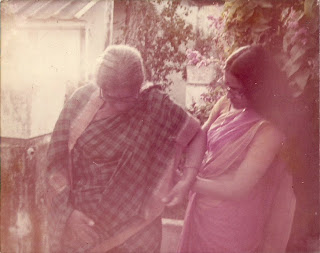


All this light stuff apart, my expert taught me all that has helped me survive, all that has made me who I am, all the strengths needed to face life.

And, as is the way with the best of experts, she did it via example. The example of selfless service, of the ability to listen without judging, of offering, instantly and without reservation, a pair of cuddling arms.

My expert taught me all that is needed to practise Dasya Bhava.

Maa, tujhe Salaam!