I had not heard of Nesser when I picked up the book. Initially, it was a bit disconcertingly unlike the usual Nordic Noir crime novels. However, it soon dawned on me that this was quality writing. A good book is one which enchants and informs. And this Nesser has opened me to music and cinema and more in the most delightful way. However, it is also fairly satisfactory as far as mystery goes.
The most heinous part of a crime such as murder is the silence - the silence of death, of the victim, of scared witnesses, of the murderer. Here is a novel that offers all these and more.
The most heinous part of a crime such as murder is the silence - the silence of death, of the victim, of scared witnesses, of the murderer. Here is a novel that offers all these and more.
When during the heat of a sweltering summer an anonymous woman caller telephones Acting Chief of Police Kluuge informing him that a girl is missing from the summer camp of the strange religious sect, The Pure Life, he sends for Chief Inspector Van Veeteren.
Unlike so many fictional detectives, Van Veeteren is relatively well-adjusted. His combination of wryly matter-of-fact observations and philosophical ruminations are thoroughly enjoyable -- and believable -- in this twisty layered tale that should keep even seasoned mystery fans guessing.
And there is the locale that, also, takes a twist. Nordic Noir - the very words have crunch, munch and ooze dark deep deliciousness - is associated with Sweden, Finland, Iceland, Denmark... . However, here it is an invented elsewhere, with most of the Nordic ambience intact.
One of the mysteries of a Håkan Nesser novel is the setting: It could be Sweden, but the place names sound distinctly Dutch, as does the surname of the protagonist, Inspector Van Veeteren. The action plays out in and around Maardam, a fictitious city “somewhere in Northern Europe,” with landscapes distinctly more Scandinavian than Benelux.
The interview helped me better understand the man and, as bonus, I got to see his dog - I had read that he had a dog and that he had been a school teacher.
Indeed, the novel is a delightful education of sorts. The Inspector, when not relishing cognac with coffee, or a nibble of good cheese, reads or listens to music and, as if that is not enough, catches a good film at the local cinema hall, too.
Indeed, the novel is a delightful education of sorts. The Inspector, when not relishing cognac with coffee, or a nibble of good cheese, reads or listens to music and, as if that is not enough, catches a good film at the local cinema hall, too.
 |
| M.Strīķis, via Wikimedia Commons |
In most senses, we proceed normally, tackling questions - Who is so and so? Why did x do such and such? What happens next?

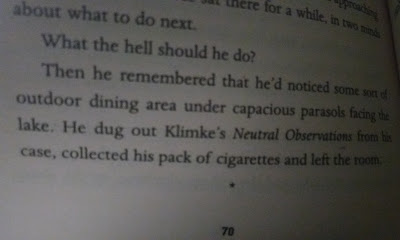
The Inspector's routine for handling 'what the hell should he do' is to sit in a beautiful spot and do something pleasurable!
As fast and furious thunder the anti-smoking brigade, so French and Japanese films, for example, seem to delight in characters who smoke and are, usually, hot. Nesser's Inspector gets my vote for ending a chapter with

Back to the book with more Bach...

Novels are prone to platitudes. The good novelist asks: What on earth do those platitudinous platitudes mean?
And, perhaps, some more tongue-in-cheek about platitudes concerning the skills of detectives:

Just as Nesser has invented the 'where' of it all, I suspect that a poet and a writer mentioned in the book are, both, fictional. Here is where the tragedy of translated fiction lies that we are at the mercy of whatever is translated and much is, necessarily, beyond our ken.
From music and literature we come to cinema. The Inspector catches a screening of Kaos by the Taviani brothers:

Notice the trio of phrases that sets the scene in our minds. Like a haiku.
And the tongue-in-cheek 'upright' envy is a marvellous phallic tribute to the moral malevolence of the 'good people'. Observe the adherence to concepts of flow - how one paragraph ends with a word and the following one echoes the precedent.
Speaking of things moral, the Inspector is agnostic. And ethics is handled here on a higher register than is usual to such works. In silence, the Inspector balances two crimes: the crime itself and the crime of false accusation.

There is more detail, in the novel, about various meals than there is, mercifully, about the brutal crimes. I mean, how many brutalised corpses can one read about, at the end of the day?

an Nesser
If I have to find fault, at times I felt, in the early parts, that there were some hiccoughs of translation - but mostly those worked out with adorable quaintness. Perhaps it is the very erudition of the author that presents a challenge to the translator.
I've yet to find a name for this genre that I detect in the book - the best way to find out would be to read another Nesser.
However, lined up for the immediate future are a Paul Theroux and a Camilla Läckberg.
As fast and furious thunder the anti-smoking brigade, so French and Japanese films, for example, seem to delight in characters who smoke and are, usually, hot. Nesser's Inspector gets my vote for ending a chapter with
"Not a minute too soon for a glass and a cigarette"

I almost always discover a "new" piece of music reading a Nesser book. Van Veeteren is quite a music lover, and this read led me to Penderecki's Requiem.
Back to the book with more Bach...

Novels are prone to platitudes. The good novelist asks: What on earth do those platitudinous platitudes mean?
And, perhaps, some more tongue-in-cheek about platitudes concerning the skills of detectives:

From music and literature we come to cinema. The Inspector catches a screening of Kaos by the Taviani brothers:
Though there is a rich IMDB page for Nesser, I cannot find anything that I can share, alas.
We have seen how the silence, in which the Inspector inspects the silences of the witnesses, is punctuated by the eternally good things of life - works of literary merit, music, food and drink and all else that is real and beautiful in life. For larger than life crimes are rarer than the media would like us to think.
We have seen how the silence, in which the Inspector inspects the silences of the witnesses, is punctuated by the eternally good things of life - works of literary merit, music, food and drink and all else that is real and beautiful in life. For larger than life crimes are rarer than the media would like us to think.
Finally, there is the process of writing which Nesser amusingly unfurls for us, with a flourish, every now and then:

And the tongue-in-cheek 'upright' envy is a marvellous phallic tribute to the moral malevolence of the 'good people'. Observe the adherence to concepts of flow - how one paragraph ends with a word and the following one echoes the precedent.

In another laudable move, without fanfare, the author brings us a world where a sari is an acceptable term, without a need for italics - such a supremely understated way of making the world one without the fanfare of a Mankell who makes the other so exotic that we can also throw in exotic crimes as natural to exotic races.

"Two bottles of beer, some crispbread, a little plastic tub of marinated garlic cloves and a few generous slices of game pâté."
 |
| Geoff Peters, Duck Liver Pâté and baguette |
is wife Elke (a psychiatristAt its core, The Inspector and Silence is an old-fashioned whodunit-style crime novel, a nicely crafted mystery with a minimum of high technology and forensics. At the end of the day, it is solid police work, feet on the ground, that solves the crime. Though clearly an anonymous tipster helps advance the investigation in meaningful, if rather abstract, ways. DI Van Veeteren seems to fancy himself along the lines of a Nordic Nero Wolfe, where his mood is only as good as his last meal. There's nothing wrong with this characterization in and of itself, but whereas Nero Wolfe's pompousness comes across as elegant and refined, Van Veeteren's comes across more as aloof and autocratic. True, he's nearing retirement and no doubt looks forward to days of wine and roses, but when compared to the brutality of the crimes he's investigating, his attitude seems a bit callous at times. But this could simply be a translation issue.
However, there are two sides to this coin - after all, it is an age where everyone is screeching "Do something!":
Van Veeteren is faced with a case of the most horrible nature, in which he has little evidence. He must solve it with a combination of logic and intuition. He has only ever failed to solve one case, for he builds them slowly, contemplatively, patiently. He watches and waits. And this method works for him: the cases are almost always solved. Some readers may enjoy partaking in this grimly methodical manner of deduction. Some may be bored senseless.
If I have to find fault, at times I felt, in the early parts, that there were some hiccoughs of translation - but mostly those worked out with adorable quaintness. Perhaps it is the very erudition of the author that presents a challenge to the translator.
I've yet to find a name for this genre that I detect in the book - the best way to find out would be to read another Nesser.
However, lined up for the immediate future are a Paul Theroux and a Camilla Läckberg.

